Chapter 3
Morning again. "The holidays are over, one might say." Kostya thought, having noticed today's date. Casting a malevolent glance at his alarm clock, which had awakened him against his will, Kostya rose from bed, dressed, washed his face, and made coffee. While performing all these ordinary procedures, he grew somewhat melancholy. Of late, his life had been devoid of any particular variety, and even such simple actions were perceived as oppressive constancy, each time reminding him that nothing had yet changed. Kostya sat down at his desk, placing his coffee beside him. "Whatever a man does, all these formalities deserve no honors; they are utterly meaningless, as, indeed, is life itself."
His attention fell upon a notice informing him that tomorrow he must appear at the employment office, where he had been registered for nearly half a year now. "Tomorrow I shall have to play the hypocrite again." It was not that he did not wish to find work; he simply could not rid himself of the thought that even now this held no great significance. Why should he do anything? Kostya was convinced that all was already lost, and there was nothing for which it would be worth hastening. He took a sip of coffee. "I wonder when the money from the employment office will arrive as social assistance for the unemployed? I could use it now. I need to buy ink for the printer. I have finished my first book; I must print it out—perhaps someone will take an interest in it."
Konstantin decided to make a few entries in his new diary. Incredible as it may seem, he is writing again. For some reason, he is once more setting forth his thoughts by means of their sublimation into conventional signs and is again undertaking the composition of yet another diary. No, he will not be so pedantic as his two previous ones had been. It turns out that everything to which one devotes great effort ultimately cannot withstand close scrutiny and begins to crumble. The first diary had burned, "and, blazing with light smoke, vanished"; the second was equally vulnerable, though flames never reached it. This new diary he will write as it comes, and when it comes, without imposing upon it any form or special attention. Form is a boundary beyond which free imagination cannot penetrate. He had thought once or twice of keeping his diary in electronic form, on the computer. But this manner of expressing thoughts is rather dry; there is none of that living spasm of the hand in fits of uncontrolled inspiration.
And so... what, then, has occurred of late? To what extent has his understanding of reality approached truth since the days of those former youthful writings? Not at all; everything that was written a year, two years, three years ago remains unquestionable truth. Were he writing it all now, he would change only the intonation—he would remove the excessive doubt and indecision from his conclusions. The world is even far worse and more vulgar than he had then described it.
"I must also acknowledge that this world dwells within me as well, and I too am part of this hopeless depravity, even if I sometimes deny it." Konstantin continued recording his thoughts. "Of late I have finished writing my book... there it lies—my life, flesh and blood, resting as a symbol of the completion of nihilistic thought, as a symbol of my secret triumph and elevation above the world of ordinary people. At such moments I rejoice and suffer. I rejoice, for before me lies that in which I have transcended my own boundaries, and I suffer that I can no longer find myself on the other side. Of late my great sufferings have transformed into 'everyday unpleasantries.' The fact of the non-existence of idealism in the world no longer surprises or disappoints, no longer outrages, but is accepted as proper and normal. The everyday cares and desires of ordinary people fill all my free time and reflections."
Throughout the entire day, Konstantin did nothing of interest. He watched a film. He read Bertrand Russell. He went to the shop several times at his mother's request, and that was essentially all. The day was, as always, featureless and hopeless. Perhaps only a few times did something like an eclipse come over Konstantin. He would smile, but the smile could not physically linger long upon his face and would abruptly vanish. Several times he assumed an air of importance, knowing that it was merely a false pretense, and this falsehood was repugnant to every cell of his being, just as his smile was.
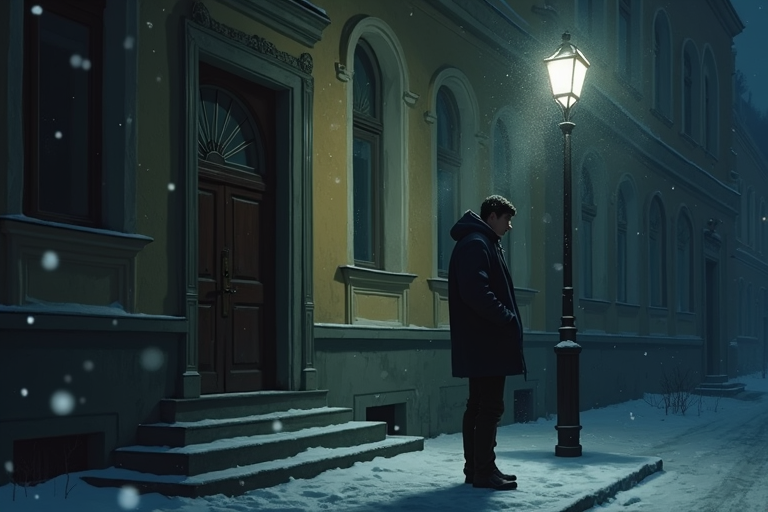
But the day was not yet over. The minute hand slowly moves upward, indicating that it is nearly seven o'clock sharp, and it is time for Kostya to perform his daily ritual. As always, to walk along the road illuminated by night lamps. To reflect, for the umpteenth time, at best upon Kant's morality, or Nietzsche's amorality, at worst—upon the futility and meaninglessness of existence. But he goes with the hope that perhaps this very walk will change something. Although Konstantin himself never acknowledged hope as such, always considering it useless, and perhaps even harmful. He often quoted Nietzsche, who said: "Hope is the worst of evils, for it prolongs human suffering. The more tragic a man's fate, the more unyielding and defiant hope becomes."
The telephone rang.
"Hey, Kostyan. Coming out today?" came the voice in the receiver—Kostya's old university classmate, Nikita Pirozhkov.
"Yes, why not," Kostya decided.
"Where shall we meet?"
"Let's do it as usual—you head toward me, I'll head toward you. We'll meet somewhere near the park. I'm leaving now."
"All right, let's go." Nikita hung up.
On his way, Kostya bought cigarettes, which consumed nearly all of his present financial means. "And this is a man who studied at the economics faculty? This is an irrational allocation of financial resources. No wonder Liza left me, precisely during those times," Kostya mentally reproached himself.
"So what do you intend to do?" asked Nikita, sitting down at a table in the café where the young men had decided to have coffee.
"Nothing for now, I'm not thinking about it. Finally finished my first book," Kostya answered honestly.
"Listen, man, you need to start a business. I've come up with something. In our city there's no competition in this kind of business. Want to hear about it?" Nikita had long ago established for himself that money is the main thing in life, and the more the better.
"Well, go on, tell me," Kostya uttered without particular interest. He knew that whatever this idea might be, nothing would come of it. There had already been many ideas, and most of them quite absurd.
"We open a sushi bar, but like, one that operates around the clock. Sushi can be ordered for home delivery. We also open branches like little kiosks, similar to those where they sell hamburgers, hot dogs, and so forth. Those are 'fast food,' and ours will be 'fast sushi,'" Nikita smiled with fanatical enthusiasm. "I've even found similar business plans. Basically, I need you to look at them, because without you it's somehow difficult to figure all this out."
Kostya, not sharing Nikita's ambitions and deciding he did not particularly wish to argue with him, replied:
"All right... I'll think about it later." At the moment, Kostya's mind was preoccupied with his new book on philosophy. Although somewhere he understood that this was just as meaningless as the conversation about Nikita's "sushi bar."
"How's Henry?" asked Nikita.
"He's fine, at work," Kostya answered. Henry worked as a laborer at a wholesale warehouse. After the holidays, he had returned to his regular schedule—one week on, one week off.
"And how's Elizabeth—still not speaking?" Nikita asked a thoroughly unnecessary question.
"To be honest, I don't particularly want to talk about it, and besides, it's time to head home," Konstantin concluded the conversation.