Chapter 2
Morning. Kostya opened his eyes. "The day will pass deaf to my desires and bring none of them to fulfillment," he recalled the words from Goethe's Faust. Konstantin's favorite book. Being a connoisseur of good books, he particularly loved rereading certain ones, such as Emmanuel Goethe's Faust or Hermann Hesse's Steppenwolf. Having thought thus about this day, he had already condemned it to meaninglessness and facelessness.
Kostya got up, walked to the kitchen, and greeted his family—his younger brother and mother. His younger brother was named Illarion; he attended school, though not always diligently due to his frequent illnesses. His mother Nadezhda was an elementary school teacher. His father Augustine was not in the kitchen when he arrived; despite such a benevolent name, his father worked in law enforcement and was already somewhere halfway to his precinct. Holidays had no particular effect on his work. Today was another day when Kostya had risen after ten o'clock in the morning. Kostya made himself coffee and retreated with it to his room.
He often thought about moving out from his parents' place into his own apartment. Not because they had any disagreements, but simply because he felt he needed to be alone, to learn self-reliance. John Milton said that solitude is sometimes better than society. It was precisely this complete solitude that Konstantin lacked.
"Today is Tuesday. What plans for the coming day? None, it seems. Yesterday I finished my first book—a weight off my shoulders. I don't expect much from it, but still, it feels as though I've freed myself from a small burden. Though I need to change the title—what kind of title is 'Confessions of the Third Nihilist'? Well, the meaning is clear enough: Schopenhauer, Nietzsche, and I—the third nihilist. But it doesn't sound right at all. Perhaps simply 'Existential Nihilism.' Yes, let it be that..."
For the next three hours, Kostya wrote his second book, on the history of philosophy. He did not know why he was doing this—perhaps simply to distract himself from certain other thoughts. His first book had been a collection of his reflections, without any particular system. The only thing that united them was their pronounced nihilism and pessimism. Therefore, in his second book he resolved: less pessimism, more philosophy itself.
Konstantin had always been interested in philosophy and the occult sciences, but could never reconcile the two. Reading occult sciences after philosophy, he felt it was all pure fabrication. At other times, philosophy could not provide the needed answers and seemed too earthbound.
Among the occult sciences, our hero was most interested in necromancy and demonology. Somewhere within, he preserved a faith in these two branches of occultism. He was never averse to hypothetically selling his soul to a demon—from the very moment he first saw his beloved Elizabeth.
I would like to spare the reader the tedious recollections of the past and plunge straight into the heart of the matter. These wishes are quite sincere, yet one cannot omit important details of the past that are necessary for a proper assessment of future actions.
Passing over the particulars of Konstantin's childhood, one must recall precisely his university years. As so often happens, it was a new chapter in his life, as it is for every person. For Konstantin too, it was a new chapter. Despite all his philosophical inclinations, Kostya enrolled in the faculty of economics.
More than other subjects, he excelled in mathematics, accounting, foreign literature, and later—philosophy. He astonished his teachers with learned words, quotations from philosophers, and his passive attitude toward grades. Several olympiads in mathematics, computer science, and literature were honored to have such a participant as Konstantin.
After his first year, he began writing his first book on philosophy, which was finally completed only now. At that time, besides the gift of writing, our hero also received a "gift from heaven," if one may put it so. The consequences of what happened then are felt to this day. Strange, that a few minutes of the past can influence one's entire future life.
But in the second year, a parallel group was formed. It would have been entirely unremarkable were it not for one young woman who came with this group. The young woman was very beautiful—neat, lovely features, a delicate figure, black hair, gray-blue eyes. She appeared precisely when Konstantin's heart had already cooled from former agitations and was earnestly seeking a new ideal. But her beauty was far from all that distinguished her. She possessed a sharp wit; like Kostya, she too had the highest marks in mathematics. This young woman stood apart from the others in her style of dress, in which black predominantly prevailed. But no... it was not her clothing that caused Kostya's interest in her—there was something mysterious about her. Mystery, enigma—this is precisely what attracted him as a philosopher, yet he was also a simple human being. The man beheld her beauty and at the same time a certain sorrow; indeed, a shade of melancholy could be read in her eyes. This was paradoxical, and therefore curious. And, of course, her "negations." Through her style, she too, like Kostya, rejected the norms of society; she too often entered into disputes, and her changeable and contradictory character reminded Konstantin of himself. What more did Konstantin need to fall irrevocably in love with her at once? All her other ideal and not-so-ideal qualities were idealized by his consciousness already prepared for it.
The idea of introducing himself arose from their very first encounter, but Kostya feared something—something like what is happening now. He began speaking with her as soon as he had gathered his courage and thoughts; this occurred at the end of the first semester of his second year. After yet another examination, he watched as she came joyfully out of the classroom, merrily informing her fellow students that she had passed the exam.
"Elizabeth." Kostya knew only her name from the parallel group.
"What?" she asked, still joyfully.
"Come here." Kostya stood with an important air by the wall, his entire demeanor showing that she aroused no particular feelings in him. Of course, this was the most blatant lie. Elizabeth approached him lightly, yet somehow cautiously. "A good sign, probably," thought Kostya.
He wanted to ask something about the examination, but upon seeing her up close, he asked what he had somehow wanted to ask even earlier. Perhaps this happened out of confusion, though on the other hand, whom else would one ask such a thing if not a beautiful young woman of the gothic style?
"Have you ever summoned spirits?" Kostya asked, as if not in his own voice.
"Why haven't I? I have," she replied—how many other different stories Kostya would hear from Liza, which, as later became clear, had little in common with reality. Her gothic style of that time was only a screen behind which a very sweet creature was hiding. This was of no particular significance; Kostya simply enjoyed the easy conversation with a young woman who, as it turned out, would influence his entire life.
Evening. Kostya set aside Irvin Yalom's book The Schopenhauer Cure and looked at the clock.
"Six o'clock in the evening," Kostya stated, rose from the bed, straightened his back—somewhere in his spine there was a slight crack. He walked to the window and opened the curtains: "How meaninglessly this day has passed again. How I would like to be more important, stronger, more needed than just an ordinary person, to feel my significance and that I am necessary to some important, complex universal system." Konstantin tried to distract himself with elevated thoughts.
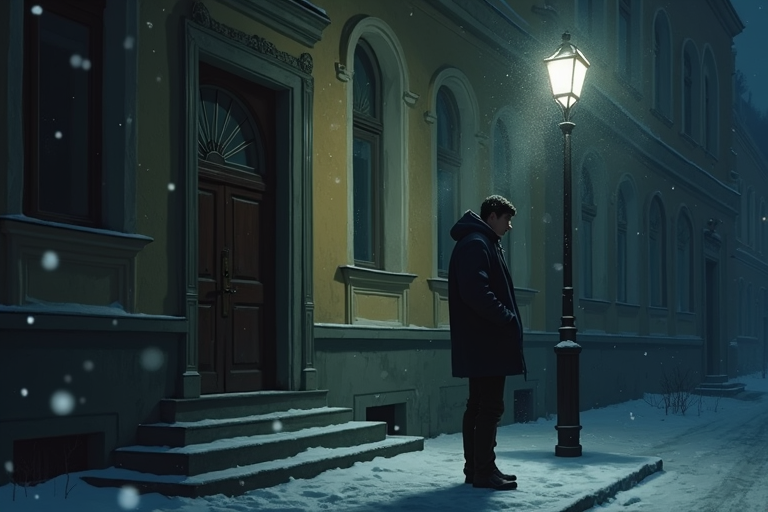
"What a blizzard," Kostya looked out the window. "I remember there was heavy snow that evening too... yes, there was... I remember as if it were today—the evening when it all began. I must feel this once more."
Kostya dressed hurriedly. "Ah... I almost forgot the most important thing—my earphones." Some people take walks while listening to music. Our hero, however, went out for a walk every day in order to listen to books. The current book was nearly finished—it was Confessions by Jean-Jacques Rousseau.
The book lover closed the door behind him and headed toward the cemetery. Strange as it may seem, it was precisely there that his first meeting with Elizabeth outside the university walls had occurred. Kostya considered this very moment the point in time from which everything began.
Outside there was indeed a snowfall. It took Kostya some time to adjust to the light frost. He turned onto that very street, at the end of which two cemeteries were situated on either side—the Jewish cemetery on the left, the Christian one on the right.
Approaching the origins of his story, Kostya looked at his watch. "Half past seven. Much snow has already fallen, and it continues to fall heavily from the sky. Just as it did then." With each step forward, memories surfaced with ever greater force. "To think, this was three years ago, yet it feels as though right now I am about to meet a strange young woman unknown to me. Indeed, Goethe was right: 'The present recedes into the distance, while the past, drawing near, acquires vividness.' The reason for such vivid memories is likely the similar weather conditions." Going to that meeting, Kostya had thought about what they would talk about. Such a meeting was a first for him. At that time he rarely communicated with people; many topics for conversation had accumulated, and essentially Kostya was only sorting through which one to begin with. "Now it seems to me that, despite my misanthropy and repellent nihilism, I still wanted to find friends. And the search for something supernatural, spirits and such—that was only a screen. Yes, indeed, I went there to find friends, but what did I find?"
Kostya walked with this flooding past all the way to the synagogue itself. "Strange, so many different events have passed, yet I remember everything in the smallest details. I remember thinking that the 'little café' at the cemetery that Liza spoke of was actually some sort of café where one could have coffee. Naturally, this was not the case at all. I remember every large snowdrift; today they are in almost the same places." Konstantin surveyed the surrounding area with his gaze. He stood near one of the lampposts, facing the gates of the Jewish cemetery, just beyond which stood the old, abandoned synagogue. Against his will, he began to remember.
The first awkward meeting. Liza came with a friend named Julia. Together they walked through the entire cemetery, to its very end. From the place they had reached, part of the city was visible. Konstantin, sensing the contrast between what lay before his eyes and what was behind him, broke the silence with these words:
"Strange... before my eyes is the anxious, noisy city. Cars, buildings, in every window a light, and behind me—silence, peace, serenity, even a certain mysteriousness. All those people living there, hurrying somewhere, have no suspicion and do not think that the mysterious, which is here, is in reality very close to them."
"My advisor, Karolina Anatolievna, told me that I should get to know you," Liza announced, having listened to Kostya's monologue.
"Hm... strange, and why did she say that?" Kostya was genuinely surprised then. This, he must admit, rather flattered him. He knew Karolina Anatolievna; she taught him foreign literature, and naturally they had much to discuss during class. "You remind me of Pierrot, from the adventures of Pinocchio," Kostya recalled Karolina Anatolievna's words. Yes, perhaps at times this was indeed so.
"Cold." With a shudder, Kostya came back from his memories. It was probably even colder then, but who felt the cold at that time? Kostya approached the cemetery gates up close, touched the cold iron with his hand, and bowed his head. "Sad. Very sad. What happened next? What else did I say then? Ah, yes..." Afterward, they went inside the synagogue. Elizabeth and Julia lit ladies' cigarettes with an apple flavor. Kostya took out his Marlboros. Cigarettes too have their own taste and smell. Sometimes the sensation of a certain smell or taste can evoke the same feeling and state of soul as when one first experienced them—this is called "emotional anchors," I believe. Kostya still remembers the smell of those cigarettes. He paced about the synagogue with a demonstrative air. He stopped; a certain verse came to his mind, and he asked Liza and Julia:
"Would you like a verse from Johann Wolfgang Goethe's Faust?" For some reason it was precisely this verse he remembered at that moment, and after receiving an affirmative answer, he began to recite in a solemn tone:
"Margaret:
Do you believe in God?
Faust:
My darling, do not touch
Upon such questions. Who among us dares
To answer unabashed: 'I believe in God'?
And yet the scholar's and the priest's retort
On this account is so sincerely foolish
That it seems a wretched mockery.
Margaret:
So you do not believe, then?
Faust:
Do not distort
My words, O light of my eyes!
Who, upon trial,
Whose reason
Would dare to say: 'I believe'?
Whose being
Would arrogantly say: 'I do not believe'?
In Him,
The creator of all things,
The foundation
Of everything: of me, of you, of space,
And of Himself?
Or is there no heaven above us,
Or is there no earth beneath our feet,
And do the stars' twinkling flames
Not pour their gentle light upon us?
Is it not I who now gaze
Into your eyes with penetration,
And is not the presence of the universe
Invisibly yet palpably near us?
So then, arise in its presence,
Feel in its light
The fullness of existence,
And call it then
Love, happiness, divinity.
There are no fitting correspondences,
And no sufficient names.
All is in the feeling, and the name
Is but smoke by which the brilliance of radiance
Is needlessly obscured."
He had just repeated this verse word for word. "Imagine, I still remember it," he thought.
After all this, they headed home. There were still some minor details, among which was Kostya's remark that "there are far more good people than living ones." In fact, this was not his own aphorism; before this meeting at the cemetery, he had read a couple of suitable aphorisms to use if the occasion arose. "Well then, time to return to the present." Kostya gathered his strength and through the unceasing snowfall headed home. Yes, indeed, that was the beginning. Afterward came new acquaintances, disappointments, the painful experience of Liza's relationship with some fellow. How much paper had been used up, how many times manuscripts blazed in merciless fire. Kostya burned his diary, as Gogol once burned his books. Bulgakov was wrong—manuscripts do burn after all, and how they burn! Those were the times when pain flowed as blood from cut wounds, in moments of merciless suffering for Konstantin. But at the same time there were also moments of supreme delight, as though someone were rewarding Kostya for his torments.
Upon returning home, Kostya felt exhausted from this walk; he had indeed, as it were, visited the past. No diary can convey all events and their details as clearly as our memory—one need only dig a little within it. Kostya drew one more conclusion from this day. Despite what awaited him in the future, and despite all the sorrows of the past, he would not refuse to repeat it all from the beginning. At least today, so it seemed to him.